

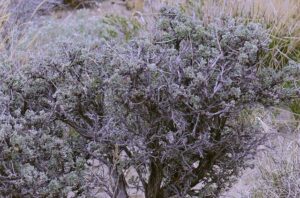
 Let’s start with an easy one, the Nevada State Flower, Artemisia tridentata, the Great Basin
Sagebrush (image available at Sagebrush Lady Bird Johnson Wildflower Center). A shrub 5 to 7 feet in height with small, narrow leaves. And while sagebrush may not have the elegance of an orchid, the smell of the sage after a rain is a quintessential Nevada experience. Great Basin Sagebrush does produce small yellow flowers in mid to late summer, as those of us with allergies know all too well.
Let’s start with an easy one, the Nevada State Flower, Artemisia tridentata, the Great Basin
Sagebrush (image available at Sagebrush Lady Bird Johnson Wildflower Center). A shrub 5 to 7 feet in height with small, narrow leaves. And while sagebrush may not have the elegance of an orchid, the smell of the sage after a rain is a quintessential Nevada experience. Great Basin Sagebrush does produce small yellow flowers in mid to late summer, as those of us with allergies know all too well. 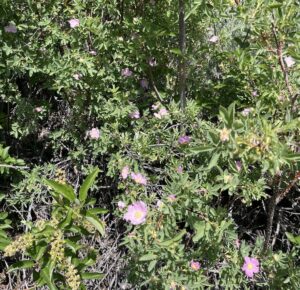 Another fragrant favorite along the trail would be Woods’ Rose or the Western Wild Rose (Wood’s Rose) While one delicate pink bloom may have a light scent, you can certainly notice when many of them are in bloom. Be careful as the dense foliage does have small thorns. After
all the blooms are done, the plant will produce pea sized rose hips in the fall. My father asked us to taste various plants on our outings and rose hips were a common offering. Rose hips are a good source of vitamin C, but I caution people against eating plants along the trail as you may have an unexpected reaction and the soil and environmental contaminants nearby might not be ideal.
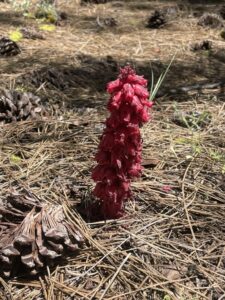 If you’re traversing some of the more mountainous portions of the TPT you may see the bright red Snowplant. Almost alien in appearance, you may find the intense red poking out of the ground in a shady spot. Snowplant’s unfurl out of the ground eventually showing bell shaped flowers the same color as the plant. Snowplant’s and their similar looking relative the Pinedrops, have no chlorophyll, they siphon energy from green plants by eating the fungus that supports the roots of the green plants. The plant kingdom’s version of sharing a Netflix password, Snowplants are freeloaders but they are so very unique looking.(Snowplant ,Pinedrop )
 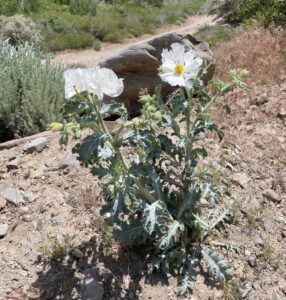 Another unique flower is the Flatbud Prickly Poppy, it has a bright white flower with a yellow center and gray green spiky leaves (Flatbud Prickly Poppy), but again, be careful as they are quite prickly. You will find them in the drier, sandier sections.
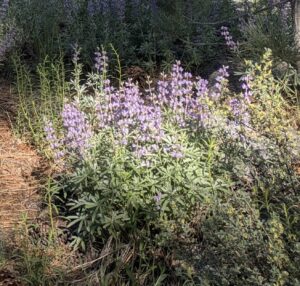 One of my personal favorites is the Silvery Lupine (Silvery Lupine Image ) with delicate little purple flowers covering tall spikes. And true to its name, the foliage is a silvery green.
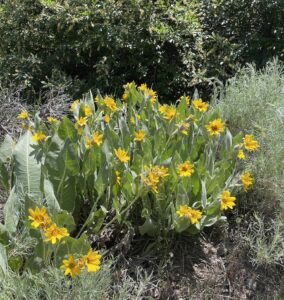 There are some showy bright yellow flowers such as Woolly Mule-ears (Woolly Mule-ears) with their long fuzzy leaves that can brighten a hillside when they are in bloom. I hope you can get outside and explore some of the small wonders along the way.